

A hazardous waste container may appear to be one of the simplest parts of a facility's waste management program. After all, its primary purpose is to hold waste until the material can be transported for treatment, recycling, or disposal.
But the wrong container can create problems long before a shipment leaves the property.
A drum that is incompatible with its contents may deteriorate. A container that is left open can allow hazardous vapors to escape. Damaged closures can result in leaks. And a container that is suitable for storing waste at a facility may not necessarily meet the requirements for transporting that material on a public highway.
Hazardous waste container requirements address these risks by establishing standards for container condition, compatibility, handling, and accumulation.
For businesses, understanding these requirements is essential to protecting employees, preventing releases, and maintaining compliance with applicable hazardous waste regulations.
What qualifies as a hazardous waste container?
Under federal hazardous waste regulations, a container is generally defined as a portable device in which material is stored, transported, treated, disposed of, or otherwise handled.
In industrial settings, hazardous waste containers commonly include:
- Steel drums
- Plastic drums
- Intermediate bulk containers (IBCs)
- Smaller laboratory waste containers
- Portable containers designed for specific chemical waste streams
- Other compatible, portable waste collection vessels
The appropriate container depends on the waste's physical and chemical characteristics, the accumulation conditions, and the intended transportation and disposal method.
There is no single container that is suitable for every hazardous waste stream.
A steel drum may be appropriate for certain solvent wastes but unsuitable for some corrosive materials. A plastic container may resist particular chemicals while being inappropriate for others.
The correct choice requires understanding what the container will hold and how it will be used.
Start with the waste, not the container
One of the most common container management mistakes is choosing a drum based primarily on availability.
A facility has an empty container, so employees use it for the next waste stream that needs to be collected.
That approach overlooks the importance of chemical compatibility.
Before selecting a container, businesses should understand:
- The chemical composition of the waste
- Whether the waste is liquid, solid, sludge, or a mixture
- Whether the material is corrosive, ignitable, reactive, or otherwise hazardous
- Whether the waste could generate gas or pressure
- Whether the container material is compatible with the waste
- Whether the waste will be transported in the same container
The process begins with an accurate hazardous waste determination.
Businesses that are uncertain about a material's classification should first understand how to determine whether waste is hazardous or non-hazardous before selecting a management and disposal pathway.
Federal RCRA container requirements establish several basic standards
Federal hazardous waste regulations include container management standards under 40 CFR Part 262 for generators accumulating hazardous waste and under 40 CFR Part 265 for certain hazardous waste management facilities.
The exact provisions that apply depend on the generator category, accumulation location, and operating circumstances.
For applicable generator accumulation areas, several principles are especially important.
Containers must be in good condition. If a container holding hazardous waste is not in good condition or begins leaking, the waste must be transferred to an appropriate container or otherwise managed in compliance with applicable requirements.
Containers must be compatible with their contents. The waste must not react with or damage the container in a way that compromises its ability to contain the material.
Containers generally must remain closed. Except when adding or removing waste, or under other specifically permitted circumstances, hazardous waste containers must be kept closed according to applicable accumulation standards.
Containers must be managed to prevent releases. Handling and storage practices should avoid conditions that could cause leaks, ruptures, or other failures.
These requirements may appear straightforward, but many compliance problems arise because facilities do not consistently apply them during everyday operations.
What does it mean for a hazardous waste container to be in good condition?
A container does not need to be visibly leaking to raise concerns about its condition.
Signs of deterioration may indicate that the container is approaching failure.
Employees should pay attention to:
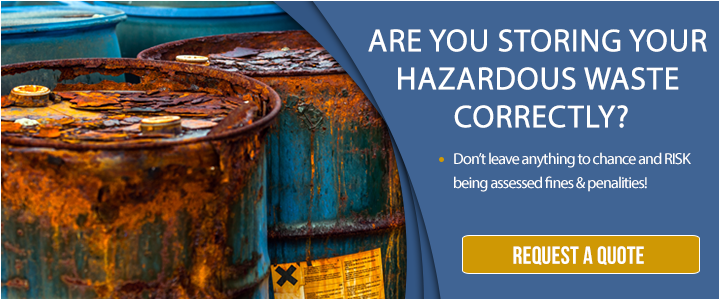
- Rust or corrosion
- Dents affecting structural integrity
- Bulging or deformation
- Cracks or punctures
- Damaged bungs or closures
- Residue around container openings
- Staining that may indicate previous leakage
- Deteriorating seals or gaskets
The significance of a particular condition depends on the container, its contents, and the circumstances.
A minor cosmetic dent may not compromise a drum. Severe corrosion near the bottom seam, however, can indicate a substantial risk of failure.
Facilities should establish a clear process for evaluating questionable containers and transferring waste when necessary.
Container compatibility is more important than appearance
Two containers may look nearly identical while having very different chemical resistance characteristics.
For example, certain plastic materials offer good resistance to some corrosive solutions but may be unsuitable for particular organic solvents.
Likewise, carbon steel may be appropriate for some wastes while being vulnerable to corrosion from others.
Compatibility evaluations should consider the specific chemical mixture, concentration, temperature, and expected storage conditions.
Businesses should use reliable manufacturer compatibility information, technical documentation, and qualified professional judgment when selecting containers.
When waste composition is uncertain, additional characterization may be necessary.
The fact that a material was previously stored in a particular type of drum does not automatically establish that the drum is appropriate for a different waste stream.
Why hazardous waste containers generally must remain closed
Open hazardous waste containers can create several problems.
Depending on the material, an open container may allow vapors to escape, expose employees to hazardous substances, increase the likelihood of spills, or permit contaminants to enter the waste.
Federal generator accumulation requirements generally require containers to remain closed except when adding or removing waste or when a specific regulatory exception applies.
For example, applicable provisions recognize limited circumstances involving equipment needed to operate safely or to prevent dangerous conditions, such as pressure buildup.
Those exceptions should not be interpreted as permission to leave ordinary waste drums open for convenience.
A funnel inserted into a drum does not automatically satisfy the closed-container requirement.
Facilities should use closure systems designed for the waste and the accumulation process, including appropriate closed-funnel assemblies where suitable.
Common container closure mistakes
Some of the most frequent problems involve containers that are otherwise in acceptable condition.
Examples include:
- Leaving a drum bung loose after adding waste
- Keeping an open funnel in a solvent waste drum
- Failing to secure removable drum lids
- Using damaged or incompatible gaskets
- Leaving laboratory waste containers uncapped
- Using temporary coverings that do not provide an appropriate closure
These mistakes often develop because employees add waste repeatedly throughout the day and view closing the container as an unnecessary extra step.
Training and properly designed collection equipment can make compliance easier without significantly disrupting workflow.
Satellite accumulation areas require special attention
Many facilities collect hazardous waste near the process where it is generated.
Under federal rules, qualifying satellite accumulation areas may allow generators to accumulate limited quantities of hazardous waste at or near the point of generation, under the control of the operator of the process generating the waste.
Federal satellite accumulation provisions generally allow up to 55 gallons of nonacute hazardous waste, subject to applicable conditions.
Separate, much smaller limits apply to acute hazardous waste: generally one quart of liquid acute hazardous waste or one kilogram of solid acute hazardous waste.
Satellite accumulation containers must satisfy applicable requirements concerning condition, compatibility, closure, labeling, and incompatible wastes.
When the applicable quantity limit is exceeded, the generator must follow the federal procedures for managing the excess, including marking the date the limit was exceeded and moving the excess within three consecutive calendar days to an appropriate central accumulation area or otherwise managing it as allowed by the regulations.
State requirements may be more stringent.
Central accumulation areas involve additional responsibilities
Central accumulation areas are locations where generators accumulate hazardous waste under the applicable generator accumulation provisions.
The requirements differ depending on whether the facility is a Small Quantity Generator or Large Quantity Generator.
For example, under federal rules, SQGs generally have a 180-day accumulation limit, with a conditional 270-day allowance for qualifying shipments over 200 miles.
LQGs generally operate under a 90-day accumulation limit.
These timeframes are subject to regulatory conditions and exceptions.
Container management requirements also address matters such as inspections, labeling, compatibility, and safe accumulation practices.
Businesses should avoid assuming that a container can remain indefinitely in a central accumulation area simply because it is properly sealed and labeled.
Weekly inspections help identify container problems early
Federal hazardous waste generator requirements generally call for weekly inspections of applicable central container accumulation areas.
These inspections are intended to identify leaking containers and deterioration caused by corrosion or other factors.
A useful inspection should examine more than whether drums are present.
Employees should look for:
- Visible leaks or residue
- Corrosion and physical damage
- Improperly closed containers
- Evidence of incompatible waste storage
- Damaged or missing labels
- Blocked access
- Conditions that could lead to container failure
When problems are discovered, corrective action should occur promptly.
Maintaining inspection documentation can also help businesses demonstrate consistent oversight and track recurring deficiencies, subject to applicable recordkeeping requirements.
Incompatible wastes must be managed carefully
Container selection is only one part of chemical compatibility.
Businesses must also consider whether different wastes can safely be stored near one another.
Some chemical combinations can generate heat, toxic gases, fire, or violent reactions.
Under applicable federal container management standards, incompatible wastes generally must not be placed in the same container unless specified regulatory conditions are satisfied.
Additional provisions address separation or protection of incompatible wastes stored in containers.
Depending on the materials, appropriate measures may involve physical separation, containment systems, barriers, or other protective arrangements.
Facilities should evaluate what could happen if a container leaks and its contents contact material from another container.
Proper segregation is therefore both a waste management practice and an important emergency prevention measure.
Secondary containment is not identical for every generator
Secondary containment is designed to capture material released from a primary container.
Examples include containment pallets, bermed areas, and other systems designed to prevent spilled material from spreading.
Secondary containment can provide valuable protection, particularly where liquid hazardous wastes are accumulated.
However, businesses should not assume that every federal hazardous waste generator container accumulation area is subject to the same universal secondary containment design requirement.
Specific containment obligations depend on the applicable regulatory provisions, waste management activity, facility type, and state requirements.
For example, permitted or interim-status hazardous waste management facilities may be subject to container containment standards that differ from the federal generator accumulation provisions.
California and other authorized states may impose additional requirements.
Facilities should determine which standards apply rather than relying on a single containment rule for every location.
Can businesses reuse hazardous waste drums?
Reusing containers may be possible, but it requires careful evaluation.
A previously used drum may contain residue that is incompatible with the next waste stream.
The container may also have suffered deterioration that is not immediately obvious.
Before reusing a container, businesses should consider:
- Its previous contents
- Potential residue contamination
- Chemical compatibility with the new waste
- Structural condition
- Closure integrity
- Applicable transportation packaging requirements
Containers used for hazardous waste transportation may also need to meet applicable U.S. Department of Transportation requirements concerning packaging condition, reuse, and reconditioning.
A drum that appears acceptable for stationary accumulation is not automatically suitable for reuse as a transportation package.
Storage containers and shipping containers are not always interchangeable
One important distinction is the difference between accumulating hazardous waste on-site and preparing it for off-site transportation.
Federal RCRA regulations establish hazardous waste generator accumulation requirements.
The U.S. Department of Transportation separately regulates the transportation of hazardous materials, including applicable hazardous waste shipments.
DOT requirements may address:
- Authorized packaging types
- Packaging performance standards
- Closures
- Marking
- Labeling
- Shipping descriptions
- Compatibility
Depending on the material, a UN performance-oriented packaging specification may apply.
Businesses should coordinate with qualified waste transportation providers to ensure that containers selected for shipment meet the applicable requirements.
This is particularly important when waste has been accumulated in containers that were not originally selected for transportation.
Container size can affect disposal efficiency
Container selection also influences operational efficiency and disposal cost.
Using containers that are too small may increase handling requirements and the number of packages needed for shipment.
Using containers that are too large can create other problems, including unnecessary storage space requirements or difficulty safely handling partially filled containers.
The most appropriate size depends on the waste generation rate, accumulation limits, material characteristics, and pickup schedule.
For recurring waste streams, businesses should evaluate container size alongside transportation frequency and disposal requirements.
A well-matched collection system can reduce unnecessary handling while keeping accumulation areas organized.
How containers influence hazardous waste disposal costs
Hazardous waste disposal pricing is affected by more than the quantity of waste generated.
Packaging can influence transportation, handling, treatment, and disposal expenses.
For example, damaged drums may require overpacking before transportation.
Improperly selected containers may need to be replaced. Incompatible materials may require special handling. And poorly organized shipments can increase labor and logistical complexity.
These additional expenses are often preventable.
Businesses that standardize appropriate container types for recurring waste streams may achieve more predictable waste management costs.
However, container selection should never prioritize a lower purchase price over chemical compatibility, safety, or regulatory compliance.
When a hazardous waste container begins leaking
A leaking hazardous waste container requires prompt attention.
The appropriate response depends on the material, quantity released, exposure conditions, and potential hazards.
Employees should follow the facility's established emergency procedures and should not attempt response activities beyond their training and assigned responsibilities.
When conditions permit safe action by appropriately trained personnel, measures may include isolating the affected area, preventing further releases, and transferring material to an appropriate container.
More serious incidents may require specialized emergency responders.
Cleanup materials and contaminated equipment may also require hazardous waste evaluation and appropriate management.
After the immediate problem is addressed, the facility should determine why the container failed and whether similar containers are at risk.
Build container requirements into everyday procedures
Container compliance becomes easier when employees do not have to make every decision independently.
Facilities can establish approved container specifications for recurring waste streams, identify designated collection locations, and provide clear instructions for adding waste and closing containers.
Supervisors should understand when a new waste stream or process change requires the container selection to be reevaluated.
Periodic reviews should also examine whether containers remain appropriate for the quantities and types of waste currently generated.
These practices support broader hazardous waste management objectives, including the principles outlined in hazardous waste disposal best practices.
The right container protects the entire waste management process
Hazardous waste containers are more than temporary storage vessels.
They protect employees from exposure, reduce the likelihood of environmental releases, support regulatory compliance, and help ensure waste can be transported safely to an appropriate receiving facility.
A container that is chemically compatible, structurally sound, properly closed, and managed according to applicable requirements reduces the likelihood of problems throughout the waste management process.
For businesses, the most effective approach is to make container selection and maintenance part of the overall hazardous waste program rather than treating drums and other collection vessels as interchangeable supplies.
The right container may never attract attention during normal operations. That is precisely the point. When containers are selected and managed correctly, they help hazardous waste remain safely contained from the moment it is generated until it leaves the facility.
Comment